NeurIPS 2026

Semantics-to-Contact

A Stagewise Framework for Robust Contact-Rich Manipulation

Guanren Qiao1, Ruixiang Ouyang1, Sheng Xu1, Yueci Deng1,2, Yunxin Tai2, Kui Jia1,2, Guiliang Liu1,3,†

1 The Chinese University of Hong Kong, Shenzhen
2 DexForce Co., Ltd.   3 Shenzhen Loop Area Institute.
† Corresponding author

The Chinese University of Hong Kong, ShenzhenDexForce
Abstract

Contact-rich manipulation requires precise control under complex contact dynamics while remaining robust to diverse visual conditions. However, real-world reinforcement learning often overfits to the visual appearance of training scenes. We propose Semantics-to-Contact (S2C), a stagewise framework for visually robust contact-rich manipulation. The insight is to decompose the problem into two stages: semantic focusing and contact refinement. In the first stage, a vision-language model localizes task-relevant regions across visually diverse scenes, providing coarse spatial guidance and reducing the burden of exploration. In the second stage, a real-world human-in-the-loop residual reinforcement learning policy learns fine-grained contact behaviors within the localized region using force feedback. To further improve visual robustness, we introduce an object-centric visual augmentation strategy that randomizes background appearance while preserving the robot and task-relevant objects. Experiments on six contact-rich real-world manipulation tasks exhibit that S2C consistently improves success rates over strong baselines and maintains reliable performance under significant visual and positional variations. These results demonstrate that stagewise semantic focusing and contact refinement provide a practical path toward visually robust real-world contact-rich manipulation.

A minute of real-world contact. From semantic guidance to robust execution.OVERVIEW DEMO · 01:00

The highlights

Focus on what matters.

See the experiments ↗
94.17%

Success in the training setting

113 / 120 trials · six tasks
78.75%

Success under visual + positional shifts

378 / 480 trials · four perturbation settings
2 stages

Semantic focusing → contact refinement

Learned through real physical interaction

How it works

Know where to go.
Learn how to make contact.

A vision-language model brings the robot to a task-relevant region. A force-aware residual policy learns the fine adjustments that turn an approach into a successful interaction.

01

Semantic focusing

From an instruction
to a pre-contact goal.

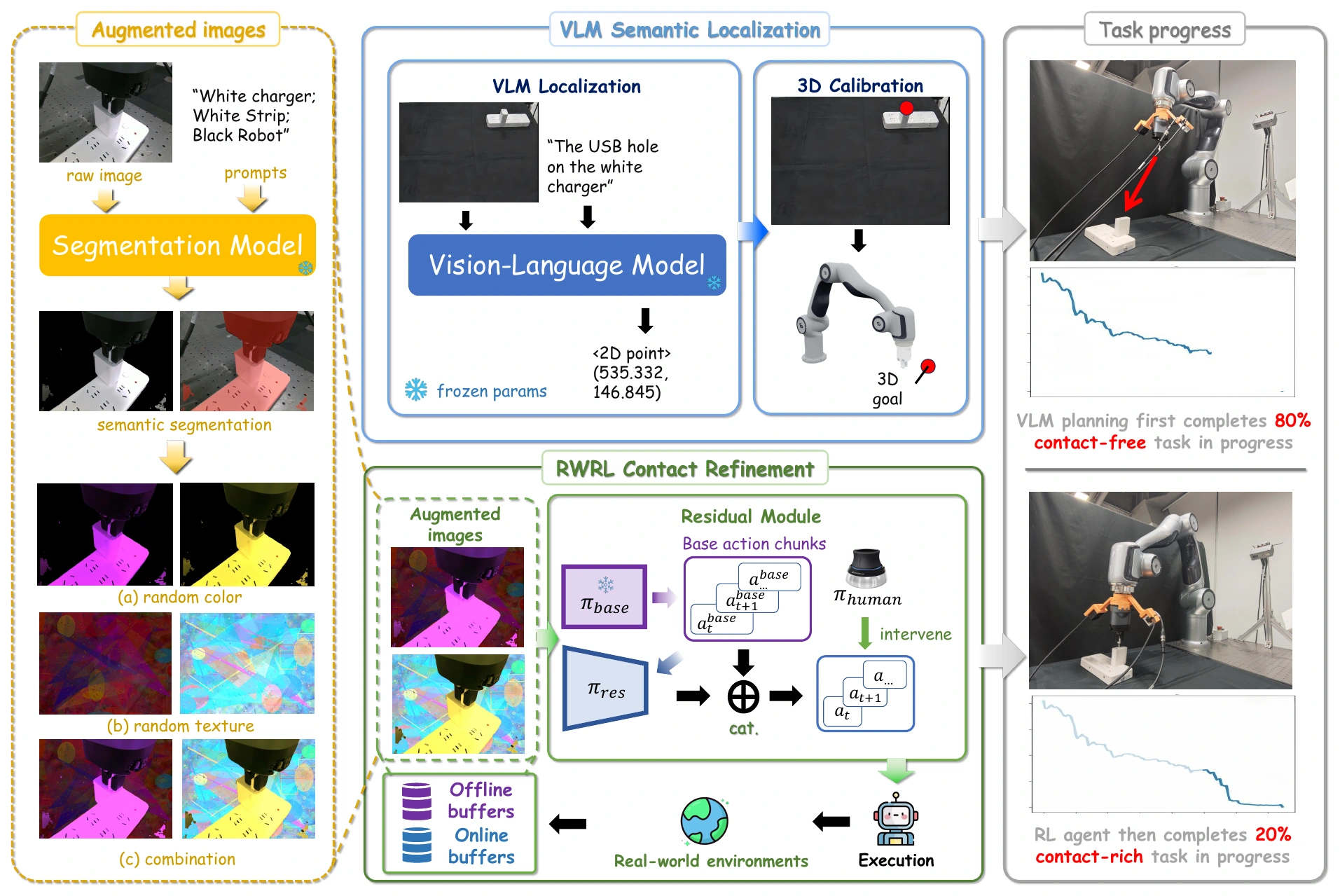
MolmoPoint localizes the target in a third-person image. Depth and hand–eye calibration turn the predicted point into a robot-frame goal; motion planning brings the arm close to the contact region.

Language + RGB-D3D localizationMotion planning
02

Contact refinement

Small corrections.
Precise interaction.

A residual reinforcement learning policy improves an ACT base policy using wrist-camera observations, robot state and force feedback. Human corrections support learning directly on the physical robot.

ACT + residual RLForce feedbackHuman-in-the-loop
S2C framework: object-centric augmentation, VLM semantic localization and real-world residual reinforcement learning for contact refinement
The complete Semantics-to-Contact framework. Open the original figure ↗

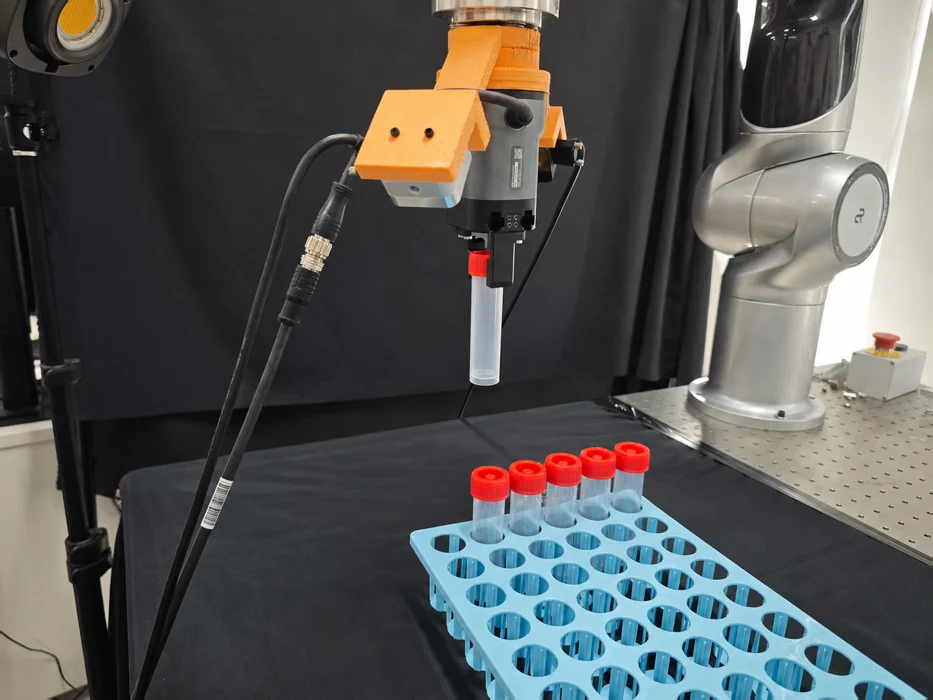
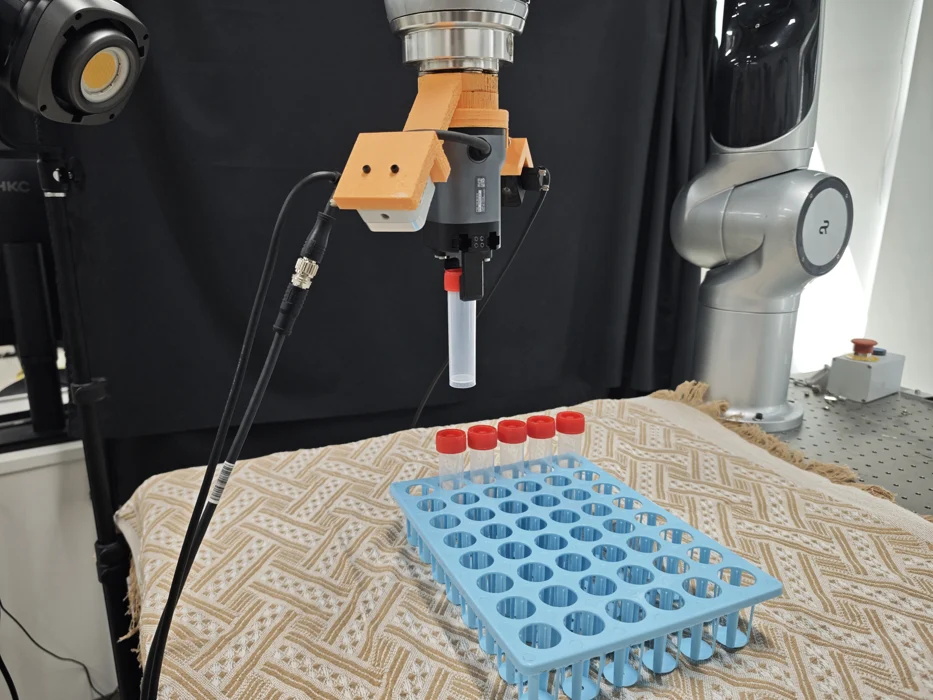
Object-centric visual augmentation

Keep the object.
Change the surroundings.

YOLOE segments the robot and task-relevant objects. Background colors and textures are randomized during training, while foreground color and brightness are also perturbed. The physical interaction remains real.

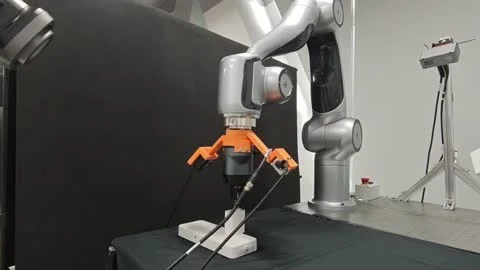
Original tabletop setup
Original scene
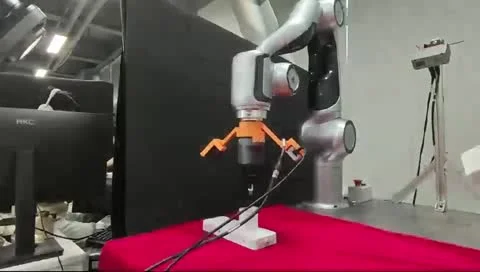
Patterned tablecloth evaluation scene
Changed visual environment

Real-world experiments

Same contact.
Different worlds.

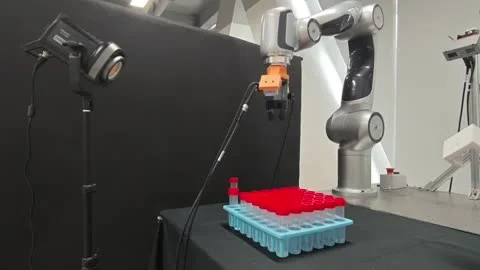
Explore all 18 individual recordings.
Select a clip to watch the full trial.

Quantitative evaluation

Robust beyond
the familiar scene.

Across six insertion tasks, S2C retains substantially higher success under combined visual and positional shifts. Each method is evaluated for 20 trials per task in each setting.

Successful trials out of 20 for each insertion task
MethodChargerUSB
Easy
USB
Hard
Tube
Easy
Tube
Medium
Tube
Hard
Average

Results are taken from the supplied manuscript. A trial succeeds when the object is fully inserted. Averages are calculated from the per-task trial counts. HIL baselines use their original initialization procedures; they do not use S2C’s VLM-guided pre-contact initialization. Reported training times in the manuscript measure learner-side optimization, not total wall-clock robot interaction.

Beyond insertion

Contact also means
letting go of the slot.

Additional removal tasks use a diffusion-policy base: test-tube removal succeeds in 9/10 trials and hard-drive removal in 10/10 trials.

Watch removal trials ↗

Understanding the boundary

Environmental robustness.
Object-level limits.

S2C tolerates many background, lighting and small positional changes. Changes inside the task-critical contact region remain difficult: replacing the charger with a black charger yields 0/10 on both charger and USB-easy tasks in the reported stress test.


Citation

@inproceedings{qiao2026semanticstocontact,
  title = {Semantics-to-Contact: A Stagewise Framework
           for Robust Contact-Rich Manipulation},
  author = {Qiao, Guanren and Ouyang, Ruixiang and
            Xu, Sheng and Deng, Yueci and Tai, Yunxin and
            Jia, Kui and Liu, Guiliang},
  booktitle = {Advances in Neural Information Processing Systems},
  year = {2026}
}